9.3
8.064 reviews

English
EN


Due to the global rise in stock prices, interest in investing in gold is decreasing, according to reports Bloomberg. The total supply of gold in exchange-traded funds fell 0.3 percent this week to 1,594.1 tonnes, the lowest level in more than five years. In 2012, the interest in these gold investments was still so great that at one point 2,632.5 tons of gold were stored in ETF's vaults.
Many speculators who thought they could make a quick profit from gold got the lid on their noses when the Gold price in 2013. Many speculators then exited the gold market and sold their shares in the gold ETFs. At the same time, there was a rush for physical gold in the form of coins and bars.
"The general direction of this market is a move away from safe-haven assets like gold and into high-yielding investments like equities.", Danske Bank's Jens Pedersen told Bloomberg. According to him, this trend will continue in the near future and interest in gold ETFs will continue to decline.
The S&P 500 index recently hit a new all-time high, while the Chinese stock market managed to rise by more than 50% in a few months. Elsewhere in the world, equity markets have also performed well, reducing interest in gold among speculative investors.
The world's largest gold ETF saw its gold holdings shrink to 709.9 tonnes this week, its lowest level since January 14 and 48% less than the record volume set at the end of 2012. However, there are also asset managers who remain true to their position in gold, such as billionaire John Paulson. He has held his position in the ETF for seven quarters in a row.
The following graph compares the gold stock in this fund with the development of the gold price. From this it can be concluded that the outflow of gold is not too bad, if you compare the decline of the last few months with that of 2013.
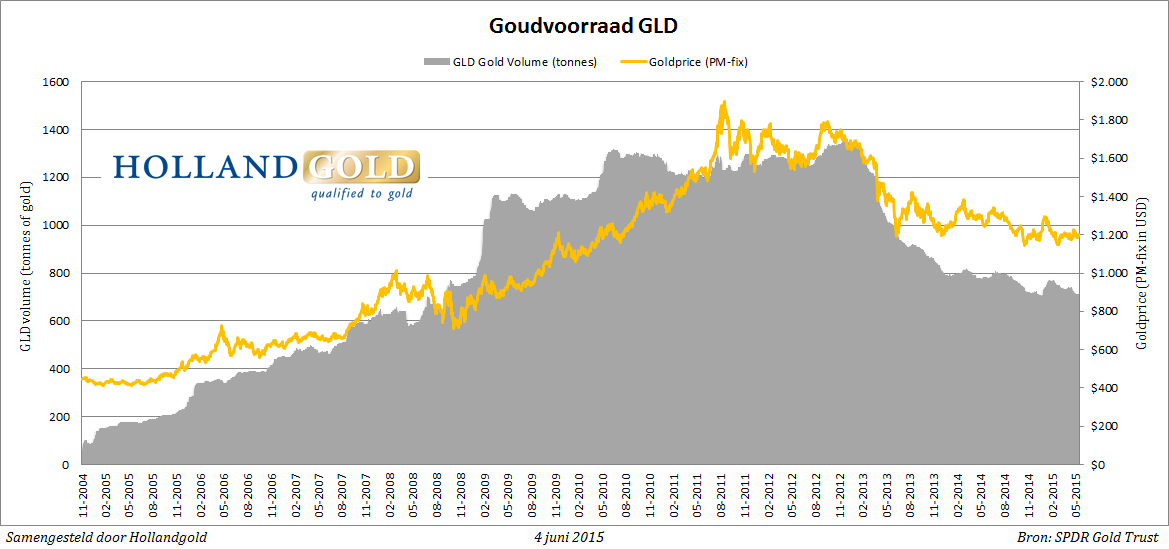
Gold stock GLD
Bloomberg compiled a series of price targets for the yellow metal and distilled an average gold price of $1,220 per troy ounce in the fourth quarter of this year and a price of $1,225 per troy ounce for next year.
"Despite all the concerns about the financial system and the unconventional policies of central banks, the gold price does not want to rise yet," Edward Dempsey of New York-based Pension Partners LCC noted in an interview with Bloomberg. For some investors, this is a signal to exit, while others use the relatively low gold price to expand their position.
Central banks continue to buy gold despite the fall in the price of gold. Over the last decade, Russia has quadrupled its gold reserves, while European countries have reduced their strategic sales of gold to zero.


