9.3
9.017 reviews

English
EN



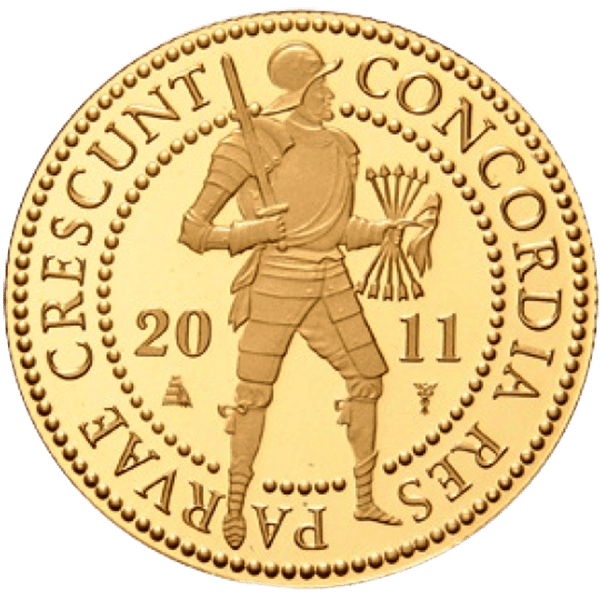
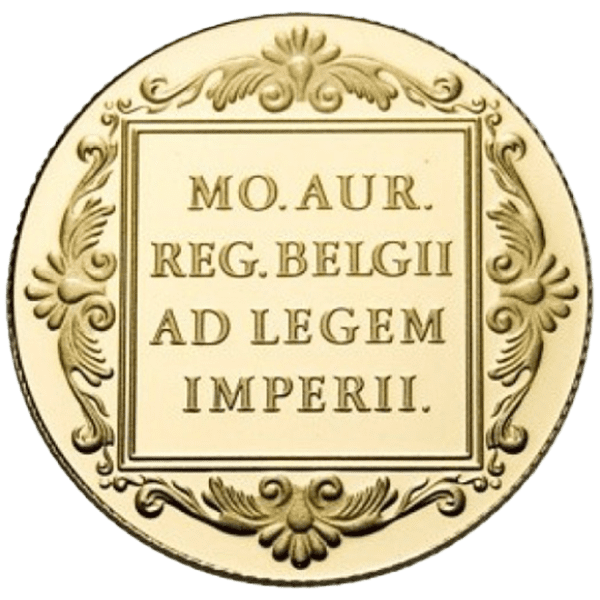
The Gold Ducat is one of the oldest gold coins still minted today. Since 1586, it has played an important role in European trade. The ducat is still issued by the Royal Dutch Mint, almost unchanged in design, as a reference to its rich trading history. Despite its low weight of 3.494 grams, of which 3.434 grams is pure gold, the ducat remains competitively priced. This is remarkable for a coin of this small size and makes it particularly attractive to investors. The ducat has a diameter of 21 mm and is notably thin, at just 0.7 mm.
The Gold Ducat contains 23.7 karat gold (0.986/1000), giving it an exceptionally high and nearly pure gold content. Only a very small amount of silver and copper is added, making the coin slightly more durable and less fragile than fully 24-karat bullion coins.
Over the centuries, millions of gold ducats have been minted — first by various provinces and, from 1808 onward, by the Royal Mint in Utrecht. Annual mintages vary greatly, making certain low-mintage years especially desirable for collectors. We offer gold ducats from various years. The year may vary and is not known in advance. The ducat is internationally recognised and widely accepted, making it easy to trade. You acquire a coin with high gold purity, Dutch heritage and strong investment value.
The Gold Ducat has featured the same characteristic design since 1586, with only minimal changes throughout the centuries. The obverse traditionally shows a standing knight with a sword and bundle of arrows, surrounded by the Latin motto “CONCORDIA RES PARVAE CRESCUNT”, meaning: “Unity makes small things grow”.
The reverse carries the long-standing Latin text “MO. AUR. REG. BELGII AD LEGEM IMPERII”, translated as: “Gold coin of the Kingdom of the Netherlands according to Imperial law”. This design is one of the most consistently used coin designs in the world and makes the ducat instantly recognisable.
Although the style has remained nearly unchanged since the 16th century, a renewed version of the knight appeared in 2018 for the first time in 32 years. This updated design maintains the traditional appearance but was subtly refined by the Royal Dutch Mint to continue its historical line.
Fun fact:
Until 1982, any Dutch citizen could have ducats struck at the Royal Mint by bringing at least 10 kg of gold. After 1982, this was no longer possible.
The Gold Ducat has a long history dating back to 1586, when the coin was officially established in Dutch coinage law. Based on the Venetian ducat, the Dutch version developed into a highly trusted trade coin with a firm place in international commerce. Thanks to its consistent weight and high gold content, the ducat was accepted worldwide — from Europe to Russia and even in Asian trade.
During the major trading periods of the Dutch Republic, including VOC voyages, enormous quantities of ducats were used as payment. The coin was so desirable that it was imitated in several countries. This emphasised the importance of recognisable features, such as the knight with sword and arrow bundle and the fixed Latin inscriptions.
Although the Gold Ducat is no longer used as currency, its design remains nearly unchanged. The Royal Dutch Mint continues to strike Single and Double Gold Ducats annually as a tribute to this trading heritage. As one of the oldest gold coins still produced today, the ducat remains a popular choice for both investors and collectors seeking to combine gold value with historical significance.
Would you like to sell gold coins? Holland Gold offers a buyback guarantee on this coin. We also purchase coins that were not originally bought from us. On our website, under ‘sell to us’, you can view the current purchase price.
| Fine weight | 3.43 Gram |
| Total weight | 3.49 Gram |
| Dimensions | Ø 21 mm x 0.7 mm |
| Purity / Content | 986/1000 - 23.7 Carats |
| Year of issue | 1603-1816 |
| Condition | Previously circulated |
| Country of Origin | The Netherlands |
| Mint House | The Royal Dutch Mint |
| Packaging | Soft plastic coin capsule |
| Safety features | No |
| Legal tender | No |
| Face value | - |
| Tax (VAT) | Exempt from VAT |
| Insured shipment possible | Yes, at a location of your choice |
| Pick-up available | Yes, in Alkmaar or Rotterdam |
| Storage possible | Yes, in the Netherlands |