9.3
8.636 reviews

English
EN


The coronavirus outbreak led to a flight to gold as a safe haven in the first quarter. In Western economies, the demand for investment gold and gold ETFs increased sharply, while the global demand for gold jewellery decreased. As a result, aggregate demand remained at about the same level as a year ago. This is what the World Gold Council in its latest quarterly report on the gold market.
Compared to a year ago, total demand for gold rose to 1,083.8 tonnes, one percent more than the same period last year. Investment products such as ETFs saw a huge inflow of 298 tonnes, but on the other hand, the demand for jewellery fell by almost 208 tonnes. And although interest in investment gold rose sharply in Western countries, there was much less demand in other parts of the world. In this article, we summarize the most important trends in the physical gold market for you.
Due to the correction in the stock market and a deteriorating economic outlook, many savers and investors in Western countries have sought refuge in gold in recent months. That caused a run on Gold bars and Gold Coins, resulting in higher premiums and longer delivery times. This is only partly reflected in the figures of the World Gold Council, because there is still a shortage in the market in April.
Globally, demand for investment gold rose 80% in the first quarter from a year ago. While the total investment demand in the first quarter of last year was 300.5 tonnes, it had risen to 539.6 tonnes in the past quarter. It is striking that the demand for coins and bars in India and China actually decreased, by 17% and 48% respectively. There are many price-conscious consumers in these countries who only buy gold when the price drops.
In many Western countries, the demand for investment gold increased, so much so that the delivery times increased. In fact, global demand for gold coins rose by 36% to the highest level in three years. This is in stark contrast to India, for example, where demand for coins and bars fell to its lowest level in four years.
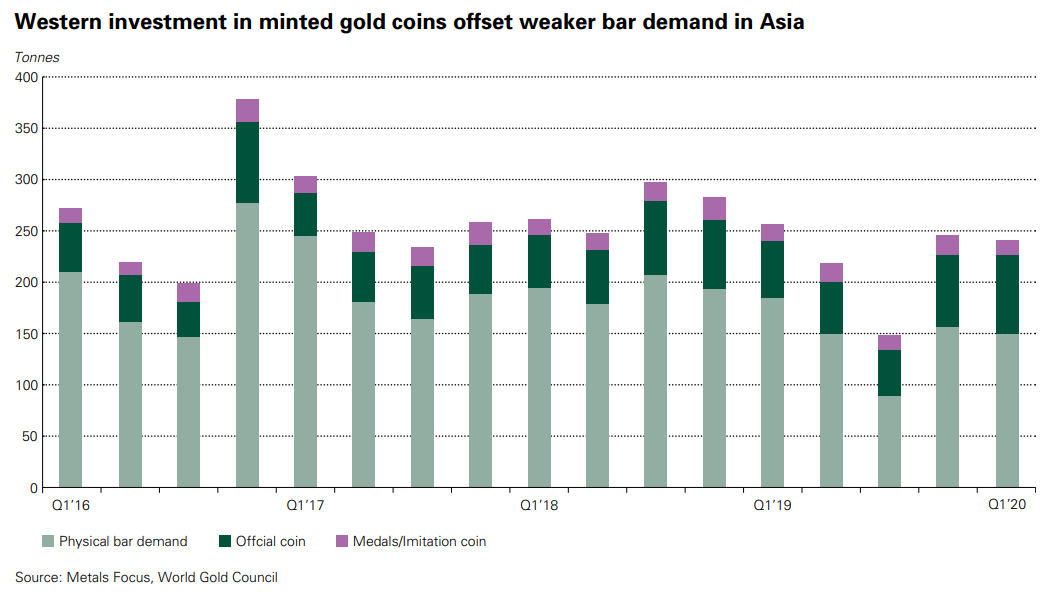
High demand for investment gold in Western countries, but not in Asia (Source: World Gold Council)
Historically, a higher Gold price coupled with a flight to gold ETFs, instruments that are particularly popular with retail investors and mutual funds. The advantage of ETFs is that they can be traded on the stock exchange just like stocks and bonds. As an investor, you do have exposure to the price, without having to arrange physical storage for precious metals.
In the first quarter of this year, ETFs' gold stocks rose to a record high with an inflow of 298 tonnes. At the end of March, ETFs managed 3,185 tonnes of gold globally, half of which was in North America and almost half in Europe. Asian gold ETFs manage much less wealth, as it is much more common to physically own gold in those countries.
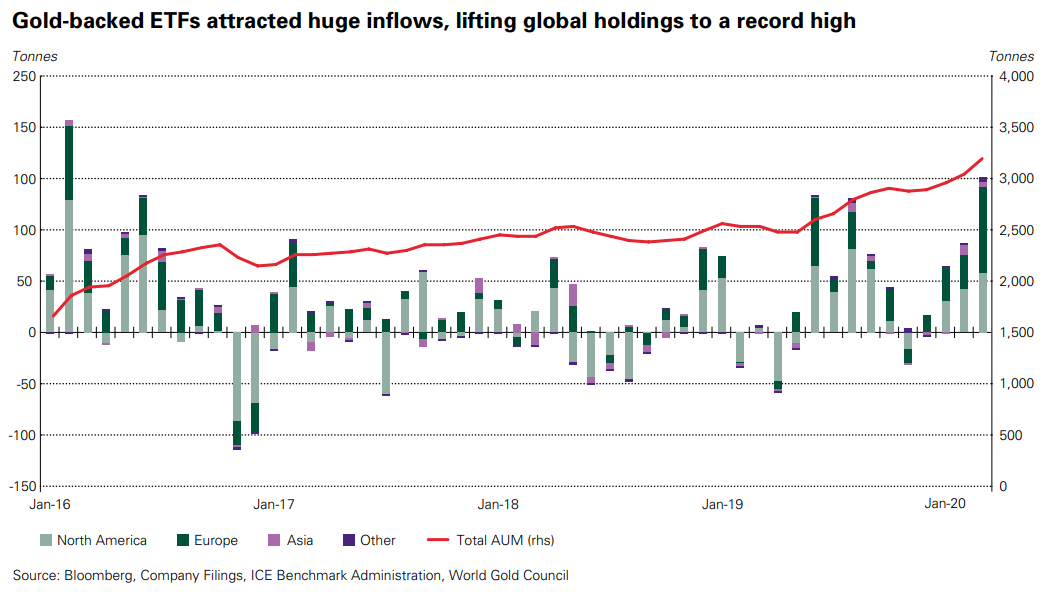
Gold stocks ETFs surged to all-time high (Source: World Gold Council)
Central banks bought 145 tonnes of gold in the first quarter of this year. That was 8% less than in the same period last year. Only six central banks bought more than 10 tonnes, compared to ten a year ago. If we look at the longer term, the pace of gold purchases is still above average. Over the past five years, central banks have bought an average of 132.9 tonnes of gold on a quarterly basis.
In recent years, Russia has been the main buyer among central banks, but that trend is also coming to an end. Lately, it has been Turkey in particular that has been expanding its gold reserves. In the first quarter, the country added 72.7 tonnes to its gold reserves. In 2019, Turkey was also at the top of the list of gold purchases. The trend of gold purchases by central banks thus remains intact, even though the composition of countries that buy precious metals is changing.
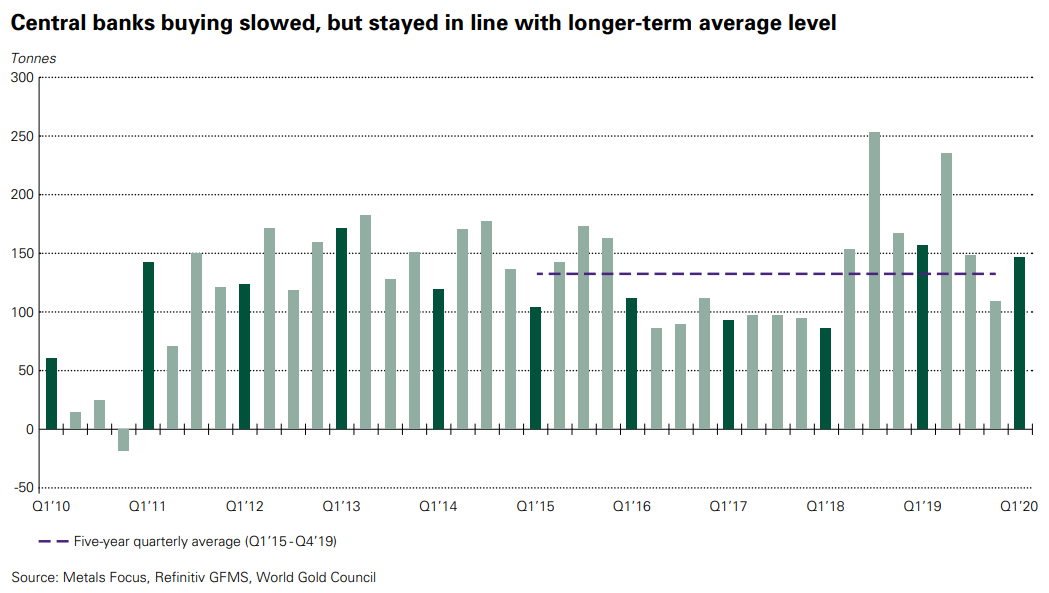
Central banks continue to buy gold (Source: World Gold Council)
The coronavirus outbreak also had an effect on the gold mining sector. In the first quarter of this year, global gold mine production fell by 3% to 795.8 tonnes. That was the lowest volume for the first quarter since 2015 and the largest percentage decline since the beginning of 2017. This was also the fifth quarter in a row in which gold mine production declined from quarter to quarter.
The largest decline was accounted for by China, the country with the largest gold mining sector. Due to the travel restrictions due to the coronavirus, many employees were unable to return to various gold mining projects after the Chinese New Year. As a result, production in China was 12% lower in the first quarter than a year earlier. Mining production also fell sharply in Peru (-17%), Argentina (-13%) and South Africa (-11%).
There were also countries that managed to produce more gold in the first quarter, for example because one or more large mining projects were started. For example, gold mining production increased in Ecuador (+51%), Burkina Faso (+18%) and Bulgaria (+18%), despite the coronavirus.
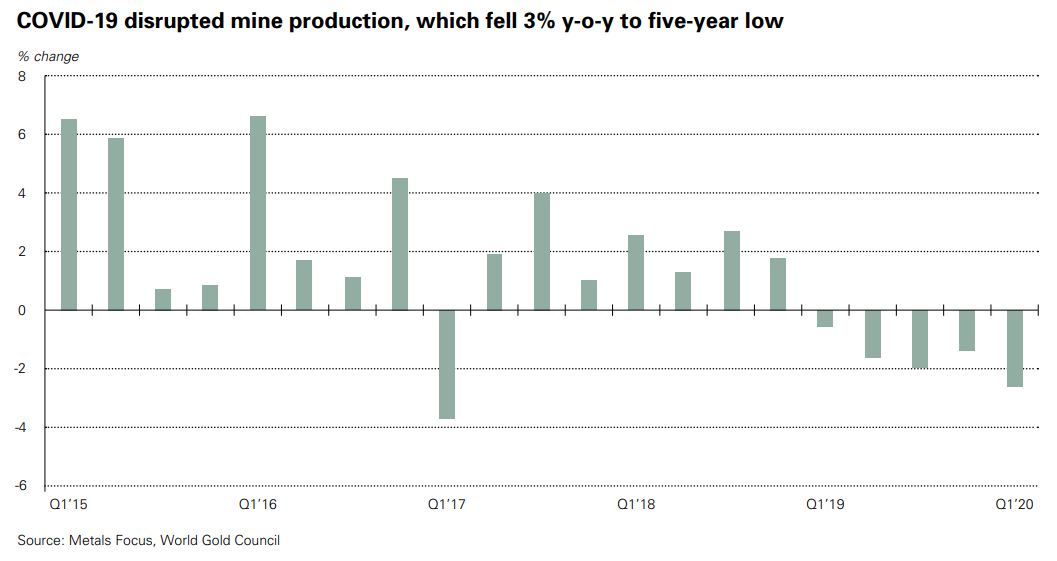
Gold mine production drops due to coronavirus (Source: World Gold Council)
Despite the sharp rise in the price of gold, the global supply of scrap gold fell by 4% in the first quarter compared to a year ago. A total of 280.2 tonnes of old gold was handed in, which is 7% less than the average per quarter over the past five years. This is remarkable, since a rising gold price normally brings extra scrap gold to the market.
According to the World Gold Council Council, this decrease can also be attributed to the coronavirus. Through Lock downs more people are staying at home and can't always go to a jeweler or gold dealer to hand in scrap gold. This was particularly effective in Asian countries, the Middle East and several southern European countries. Another explanation is that people still hold on to their gold due to increased economic uncertainty. After all, the precious metal remains a safe haven in times of crisis.

Supply of scrap gold decreases, despite higher gold price (Source: World Gold Council)
This contribution was made from Geotrendlines


