9.3
8.115 reviews

English
EN


Several developed countries have to take into account a downgrade of their credit status. Previously warn analysts at credit rating agency S&P Global. Due to the resurgence of the coronavirus, many countries are taking new measures, which will hit the economy hard. As a result, the bill for all support measures will increase even further, putting pressure on the creditworthiness of a number of countries.
Credit rating agency S&P Global has downgraded almost sixty countries since the start of the corona crisis. In most cases, these were poorer countries, which are less able to apply monetary and fiscal stimulus. Until now, developed countries have been spared, but that could now change. Roberto Sifon-Arevalo of S&P Global said:
"We are talking about credit ratings in the EU or in developed economies such as Japan, the United Kingdom and the United States. These countries have implemented gigantic fiscal and monetary stimulus programs to protect their economies. We need to see where this trend goes from here. If this [the stimulus] becomes more structural, then we're going to see some changes in credit ratings."
Some countries have taken extreme measures to mitigate the impact of the coronavirus crisis. According to calculations by McKinsey In the first two months after the coronavirus crisis, countries announced a total of $10 trillion in fiscal stimulus, of which $4 trillion was for Western European countries. By comparison, that was three times as much as in response to the 2008 credit crisis.
Due to the size of all the support programmes, the public debt in several Western countries will increase by 15 to 20 percentage points relative to gross domestic status. Developed economies such as Australia, Italy and Spain are threatened with a downgrade, as these countries now have a 'negative outlook' at S&P Global.
Western countries have the highest national debts, but because of their good credit status, they can borrow easily and cheaply. In fact, countries such as Italy, Spain and Greece have never been able to borrow as cheaply as they do now. The debt securities of Western countries are in high demand, because they are still known to be very creditworthy.
Central banks are also lending a hand. Thanks to large-scale purchase programs, Western countries can borrow at very low interest rates and allow their debts to rise further. This is also evident from the graph below, which shows that European countries pay relatively little interest charges. Emerging economies pay much higher interest rates and are therefore more likely to run into problems.
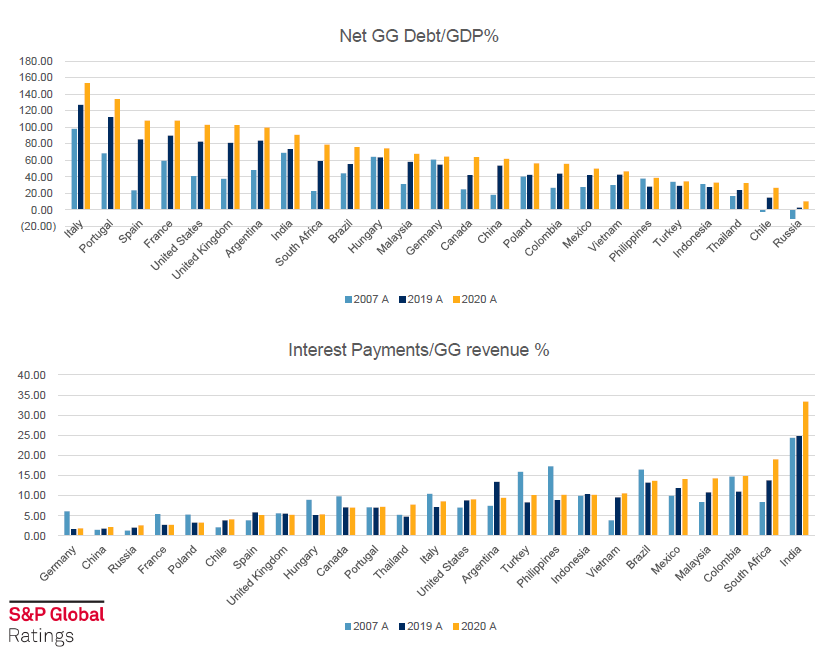
European countries have the highest public debt, but pay the lowest interest charges (Source: S&P Global)
Nevertheless, Western economies should not think that they can continue to borrow indefinitely. If interest rates rise in the future, this will hit much harder due to the high debt-to-GDP ratio. As a result, Greece and Italy, two countries with very high public debt, were the first to run into problems during the European debt crisis.
Central banks will, of course, do everything they can to keep interest rates low, especially if governments Lockdown measures to increase their budget deficits even further. The prospect of low interest rates and possibly even more monetary easing does not bode well for the purchasing power of money.
Image below the article is taken from 401kcalculator.org and is free to use under the Creative Commons license
This contribution was made from Geotrendlines


