English
EN


Two developments are bringing the prospect of another period of rising gold prices closer, according to Jack Hoogland: neither the Fed nor the ECB raised interest rates, while concerns surrounding AI stocks and bonds are mounting. Meanwhile, US national debt has increased by more than $1.2 trillion since July. He expects this will eventually force the Fed to cut interest rates and print money, which would be positive for gold and silver.
Looking at last week’s price declines, that may sound strange...
But we have seen two developments that bring us considerably closer to the start of a new upward phase.
The first was that neither the Fed nor the ECB raised interest rates, even though both have positioned themselves as inflation fighters since the start of the Iran war.
Exactly as I discussed two weeks ago in this short video clip.
The second development can be seen in the post below.
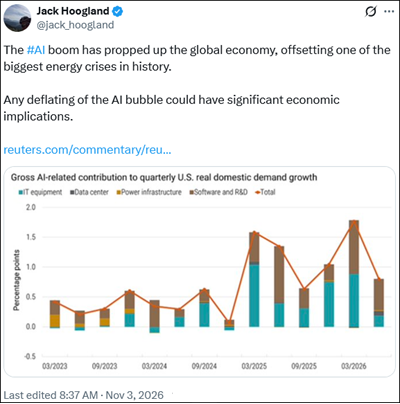
Nervousness surrounding AI-related bonds and stocks has increased sharply since last week.
A partial deflation of the AI bubble would lead to a significantly weaker economy and lower inflationary pressure.
On top of that, falling technology stocks create a negative wealth effect, putting downward pressure on consumer spending.
A weaker economy also leads to lower tax revenues, while government spending continues to rise.
That means an even larger budget deficit and an even faster increase in national debt.
Meanwhile, the post below shows that interest costs as a percentage of GDP have already risen to record levels.
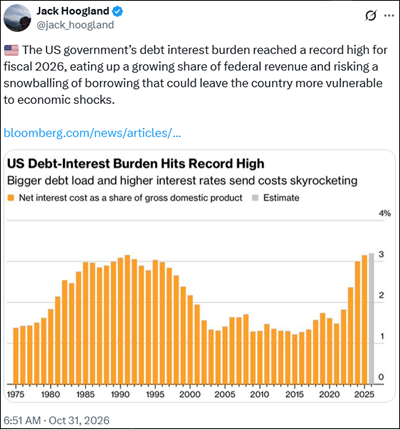 The message in the post is clear.
The US is heading towards a snowball effect, or in other words a vicious cycle in which rising interest costs cause national debt to increase more rapidly, which in turn leads to even faster-rising interest costs, and so on…
What is striking is that national debt is rising so rapidly while the economy is still growing, as the post below shows.
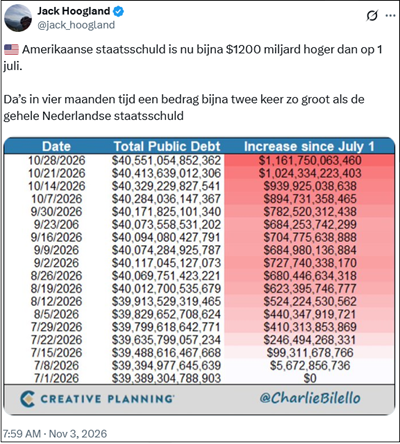
From July through October, US national debt increased by almost $1.2 trillion.
In just four months, the US added almost twice as much debt as the Netherlands has accumulated in its entire history!
To keep the interest costs on this rapidly rising national debt somewhat under control (and to prevent a recession), interest rates will need to fall substantially.
In other words, the Fed will eventually have no choice but to cut short-term interest rates sharply and print money to push yields on US Treasuries significantly lower.
And that is highly positive for assets such as gold and silver.
Rising stress surrounding AI gives us another reason to expect fears of a weakening economy to take over soon.
At that point, the Fed is likely to change its tone, while markets begin to price in a greater likelihood of lower interest rates and renewed money printing.
The result would be sharply higher prices for hard assets such as gold, silver, copper and uranium.
And share prices of gold, silver, copper and uranium companies could rise even more sharply.