9.3
8.108 reviews

English
EN


Monday was the last day that you could buy the hundred-guilder banknote with the portrait of Michiel de Ruyter. exchange at the Dutch Central Bank. About a hundred notes were exchanged at the last minute for the paltry amount of €45.38. This means that in 2016 the note only provides a fraction of the purchasing power that it provided almost fifty years ago.
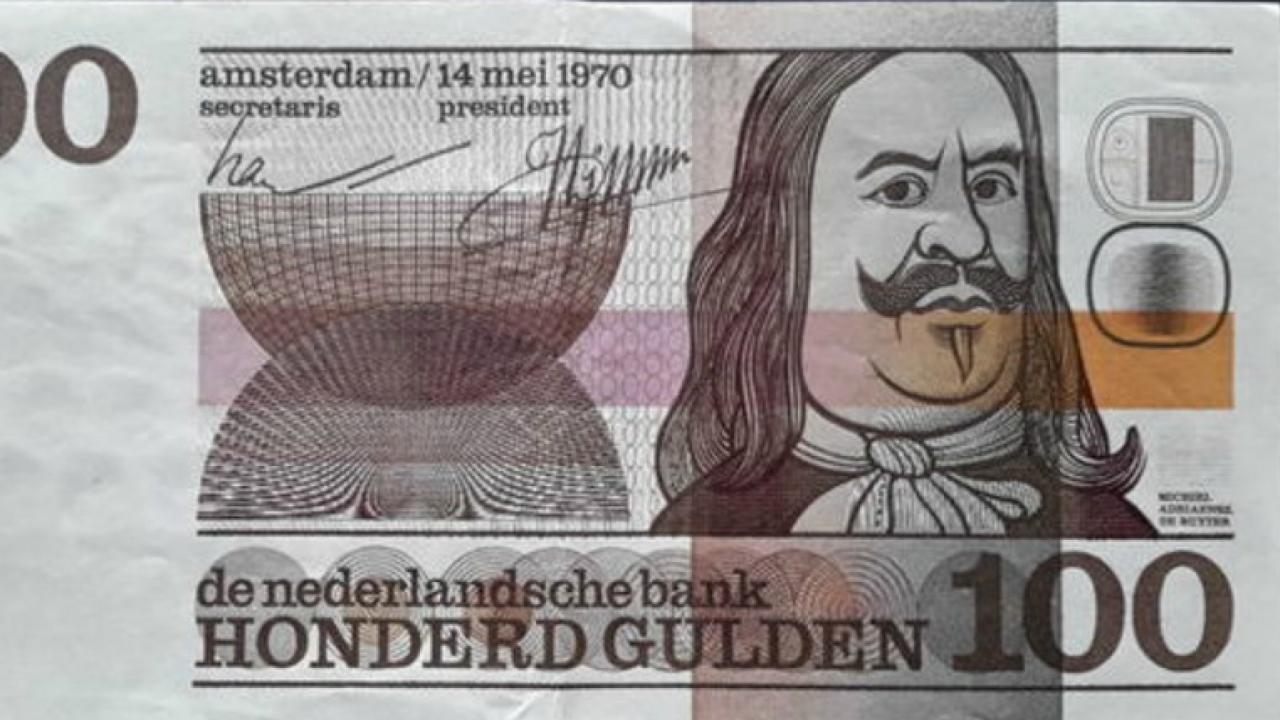
One hundred guilder banknote (Source: De Nederlandsche Bank)
Above you can see the banknote in question, the hundred guilders with the portrait of Michiel de Ruyter. We took the year of this banknote as a starting point and started doing the math. How much could you buy with this amount in 1970?
It is precisely this question that is answered on the website of the International Institute of Social History. The calculator on their site uses the official inflation figures to show how much purchasing power the money had at the time, converted to today's prices.
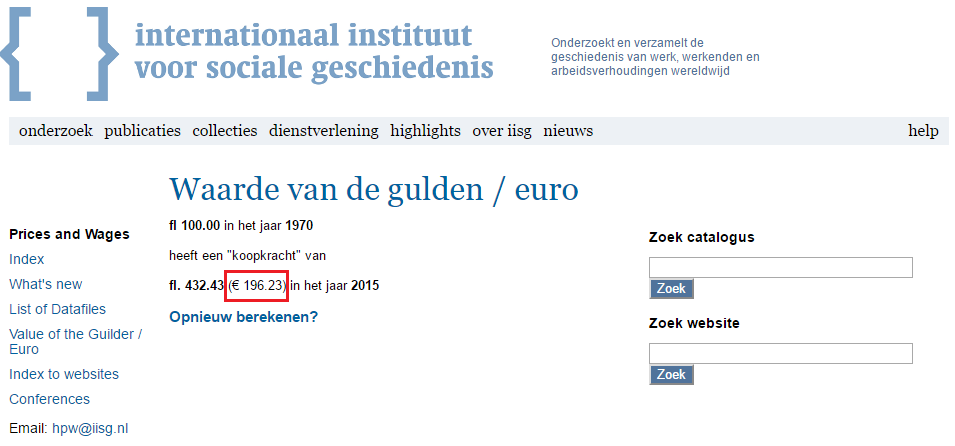
One hundred guilders in 1970 had as much purchasing power as €196.23 in 2015 (Source: IISH)
If we take the official inflation figures as a basis, we can assume that in 1970 you can buy as much with a hundred guilder note as with a hundred guilder notes as with From €196,23 in 2015. That's more than four times as much as the €45.38 you could get at the Dutch Central Bank until today.
Between 1970 and 2015, 75% of the value of this banknote evaporated. However, if you are convinced that inflation figures have been structurally understated for years, then the loss of purchasing power has been much greater than that 75%.
Adjusted for inflation, the hundred-guilder note has lost a lot of purchasing power, but how big is the loss of value measured in grams of gold? A quick search on the internet tells us that at the end of 1970 the US dollar was equal to 3.62 guilders. A Michiel de Ruyter note of 100 guilders was equal to $27.62 at that time.
If we link that amount to the gold price of $36.02 per troy ounce In the year 1970, we arrive at 0.767 troy ounces of gold. If we convert that back to grams (1 troy ounce = 31.1 grams), we arrive at a weight of 23.85 grams of gold for our hundred-guilder note.
If you hadn't exchanged the note for gold, but put it in a cupboard all those years and exchanged it today at the Dutch Central Bank, you would only get €45.38 for it. If you wanted to convert that amount into gold, you would not get any further than at the current gold price of €38.47 per gram 1.18 grams.
You read that right, measured in grams of gold, the value of the hundred guilder banknote in the past 46 years has been 95% down. As you can understand, price stability is an extremely flexible concept for central banks...


