9.3
8.524 reviews

English
EN



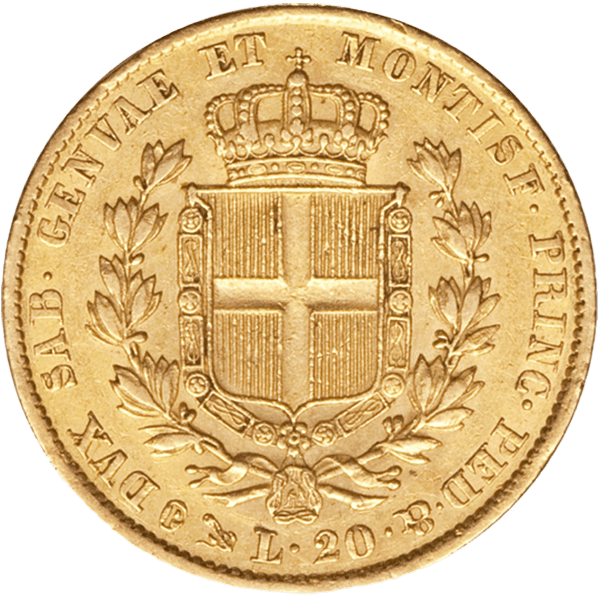
The Italian gold 20 Lire, better known as the Marengo, is a classic European gold coin. Like the 20-franc coins from Switzerland, France, and Belgium, it contains 5.81 grams of pure gold. The coin is struck in 21.6 carat (90% gold) and has a total weight of 6.45 grams. Thanks to its convenient size, universal gold content, and broad international recognition, the Marengo is widely seen as an accessible and reliable way to invest in gold.
This coin was part of the Latin Monetary Union, a unique 19th-century European currency system in which different countries minted coins with identical specifications. That made the coins mutually equivalent and allowed them to be used as legal payment across borders. Today, the system is often described as the “euro before the euro.”
The name Marengo refers to the Northern Italian village of Marengo and the Battle of Marengo in 1800, a symbol of the origins of this monetary system. The Italian 20 Lire was issued between 1861 and 1927 and features portraits of different Italian kings. It is not possible to determine in advance which year or which portrait will be delivered.
The Italian gold 20 Lire (Marengo) was issued within the Latin Monetary Union and follows the exact same technical specifications as other European 20-franc coins. It is struck in 90% gold (21.6 carat), has a total weight of 6.45 grams (of which 5.81 grams is pure gold), and a diameter of approximately 21 mm.
The obverse always shows the portrait of the reigning Italian king, surrounded by his name and title. The 20 Lire was struck under three different kings. The first two series feature Vittorio Emanuele II (1861–1878), the first king of unified Italy, and Umberto I (1879–1900), both with a classic, recognizable portrait.
The final issues depict Vittorio Emanuele III. Under his reign, the 20 Lire was struck in two distinct design periods:
The reverse remained largely consistent across all issues and shows the Italian coat of arms with a crown, surrounded by a laurel wreath. Each coin also clearly displays the denomination “20 L” and the inscription “REGNO D’ITALIA”, literally meaning “Kingdom of Italy”. These fixed inscriptions emphasize the official status of the coin as a national circulation issue within an international monetary system. The last issues under Vittorio Emanuele III also mark the end of Italy’s gold circulation coinage.
Just before the euro was introduced in 2001, 20 Italian lire had very little purchasing power: at the euro’s introduction, 1 euro was worth 1,936 lire. So with 20 lire in paper or digital money, you could practically buy nothing at all. Yet once, that same 20 lire represented a meaningful gold value accepted throughout Europe—a striking contrast with its value at the end of the lira era.
Italy is a republic today. In 1946, a national referendum decided to abolish the monarchy following the royal family’s role during the fascist period. The last king, Umberto II, reigned for only 33 days and is therefore known as “il re di maggio”, the King of May. That brought the Italian monarchy to an end, while the Marengo lived on as tangible historical heritage.
Looking to sell your gold coins? Holland Gold offers a buyback guarantee for this coin. We also purchase coins you didn’t buy from us. On our website, under the section “sell to us”, you can see what we pay for the coin.
| Fine weight | 5.81 Gram |
| Total weight | 6.45 Gram |
| Dimensions | Ø 21.2 mm x 1.3 mm |
| Purity / Content | 900/1000 - 21.6 Carats |
| Year of issue | 1808-1897, 1902-1912 |
| Condition | Previously circulated |
| Country of Origin | Italy |
| Mint House | Zecca di Stato (The Italian State Mint) |
| Packaging | Soft plastic coin capsule |
| Safety features | No |
| Legal tender | No |
| Face value | 20 Italian lira |
| Tax (VAT) | Exempt from VAT |
| Insured shipment possible | Yes, at a location of your choice |
| Pick-up available | Yes, in Alkmaar or Rotterdam |
| Storage possible | Yes, in the Netherlands |